
Increasing retail deposit conversion from 16.5% to 18.6% (+12.7%)
Increasing retail deposit conversion from 16.5% to 18.6% (+12.7%)
Estimated impact: $10.2M in additional retail deposits.
- Team
- Product Designer · Product Manager · Dev · CPO
- Scope
- Research · Funnel analysis · Product framing · UX/UI
Resolv turns crypto deposits into yield
Users deposit funds into USR or RLP, and Resolv puts that capital to work through a delta-neutral strategy.
The first deposit was the main business goal.
It turned a visitor into a customer and added new retail capital to the product.
After the deposit, yield and rewards gave users a reason to keep their money in Resolv.
- First touch
- Connect wallet
- Buy USR / RLP
- Resolv strategy
- Yield
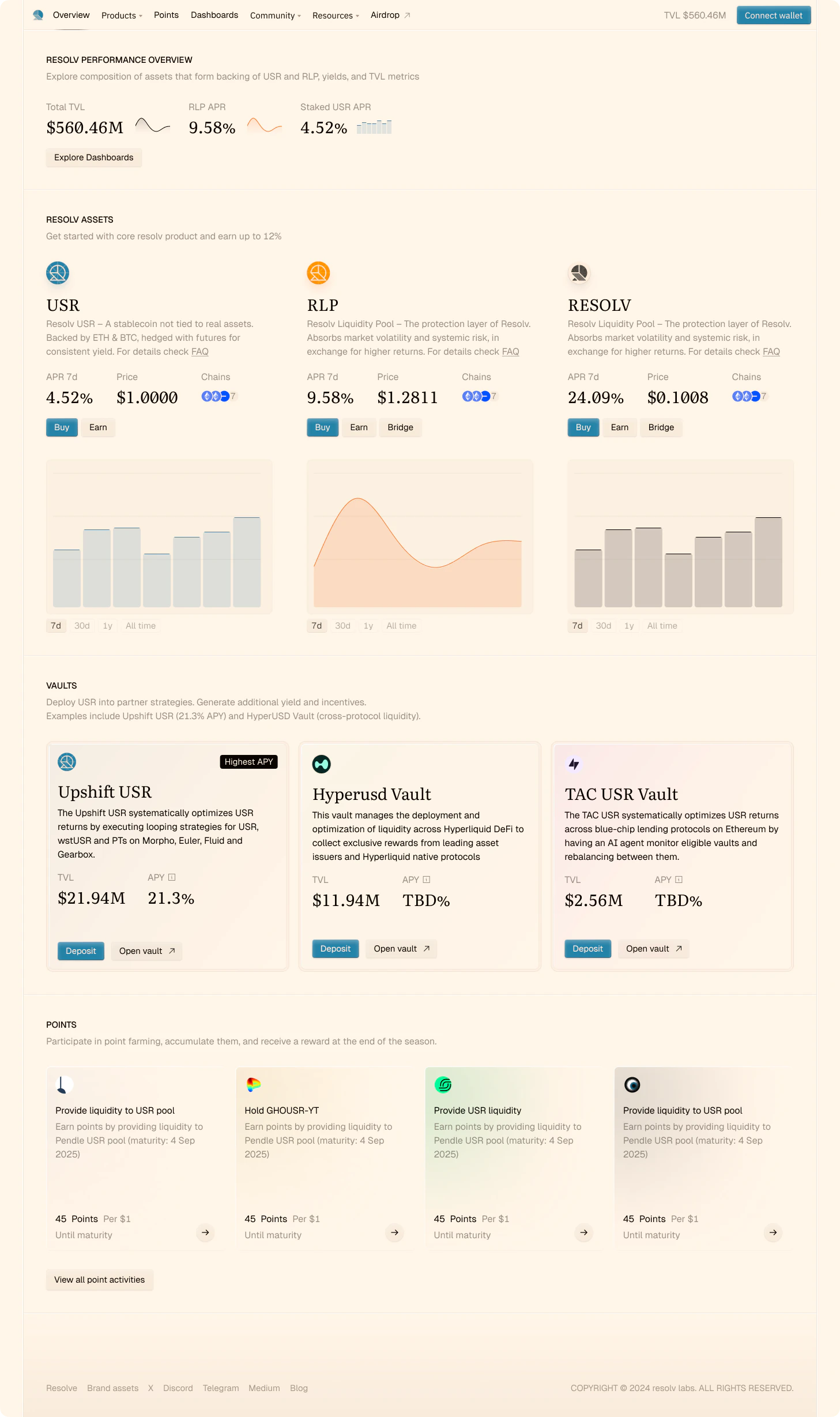
The landing explained the product, the app handled the deposit.
The landing carried the product story, the app showed technical product data and actions.
We treated the landing and the app as one continuous journey.
The landing explained what Resolv was, what made it different, and why someone might use it.
The app was intentionally minimalist: it focused on technical product information, deposits, and portfolio management.
This kept it lighter than the dense DeFi interfaces used by many competitors.
The underlying assumption was that new users would understand Resolv on the landing before opening the app.

Conversion to first deposit started to steadily decline relative to the increase in the number of users coming into the product
After the active development phase and rapid growth, analytics was gradually introduced and we moved into the stage of working on targeted improvements in every part of the product flow to grow the metrics.
It was found that we were bringing more people into the product itself, but the conversion to first deposit wasn’t growing much compared to the share of people coming into the product.
All relevant teammates got the task each from their side to figure out whether there are any issues in the product or where there might be potential growth points.
End-to-end funnel analysis.
From the very first touch a user has with the product all the way to deposit
I mapped the first-deposit funnel across acquisition sources.
The analysis showed that about 35% of social traffic entered the web app directly, rather than through the landing.
To understand why, I reviewed the posts behind those links and found that creators and community members commonly shared an app URL.
I then created two cohorts: landing-to-app and social-to-app. Comparing completed first deposits between them produced the next insight.
Landing-to-app users converted at 20%, direct-entry users at 10%.
With 100 users in each group, that meant 20 completed deposits versus 10.
I compared two equally defined groups from their first Resolv visit to a completed deposit.
Among 100 users who visited the landing before opening the app, about 20 deposited.
Among 100 users who opened the app directly, about 10 deposited.
Both groups followed the same screens and steps inside the app.
The comparison showed a clear difference between the entry paths.
New users who bypassed the landing lacked the context to deposit
Users on social networks are linked to the app instead of the landing page.
Creators/Blogger/Users often learned about Resolv on the landing, opened the app, made a deposit, and later copied the app URL already open in their browser into a post.
Their readers skipped the landing, where the main product story lived, and arrived directly at a deliberately minimalist dashboard built around technical information and actions.
The funnel showed that these users deposited half as often: 10 out of 100, compared with 20 out of 100 after the landing.
This led to the hypothesis that the break between external discovery and the action-focused app made it harder to understand what Resolv was, what made it different, and why to use it.
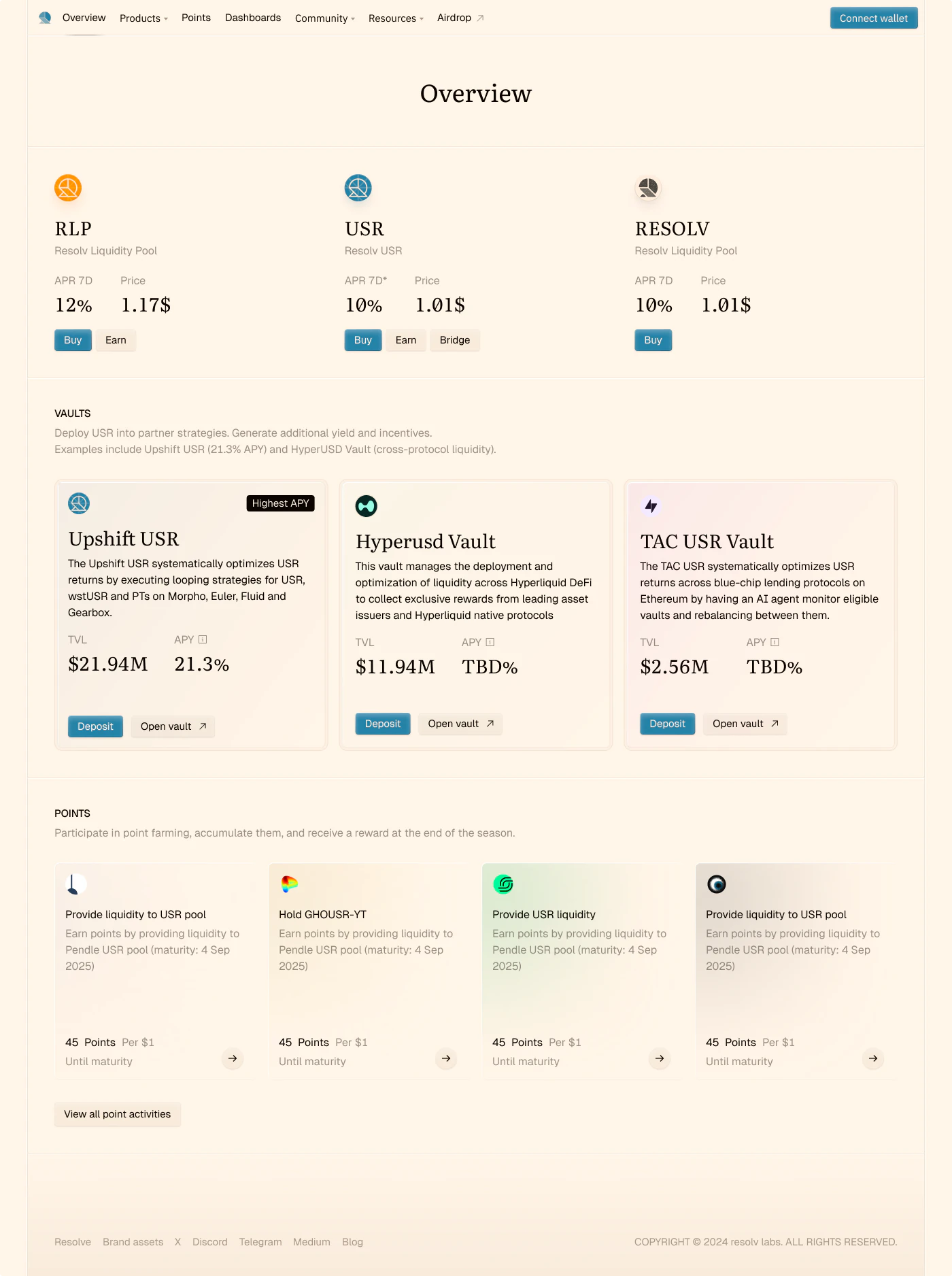
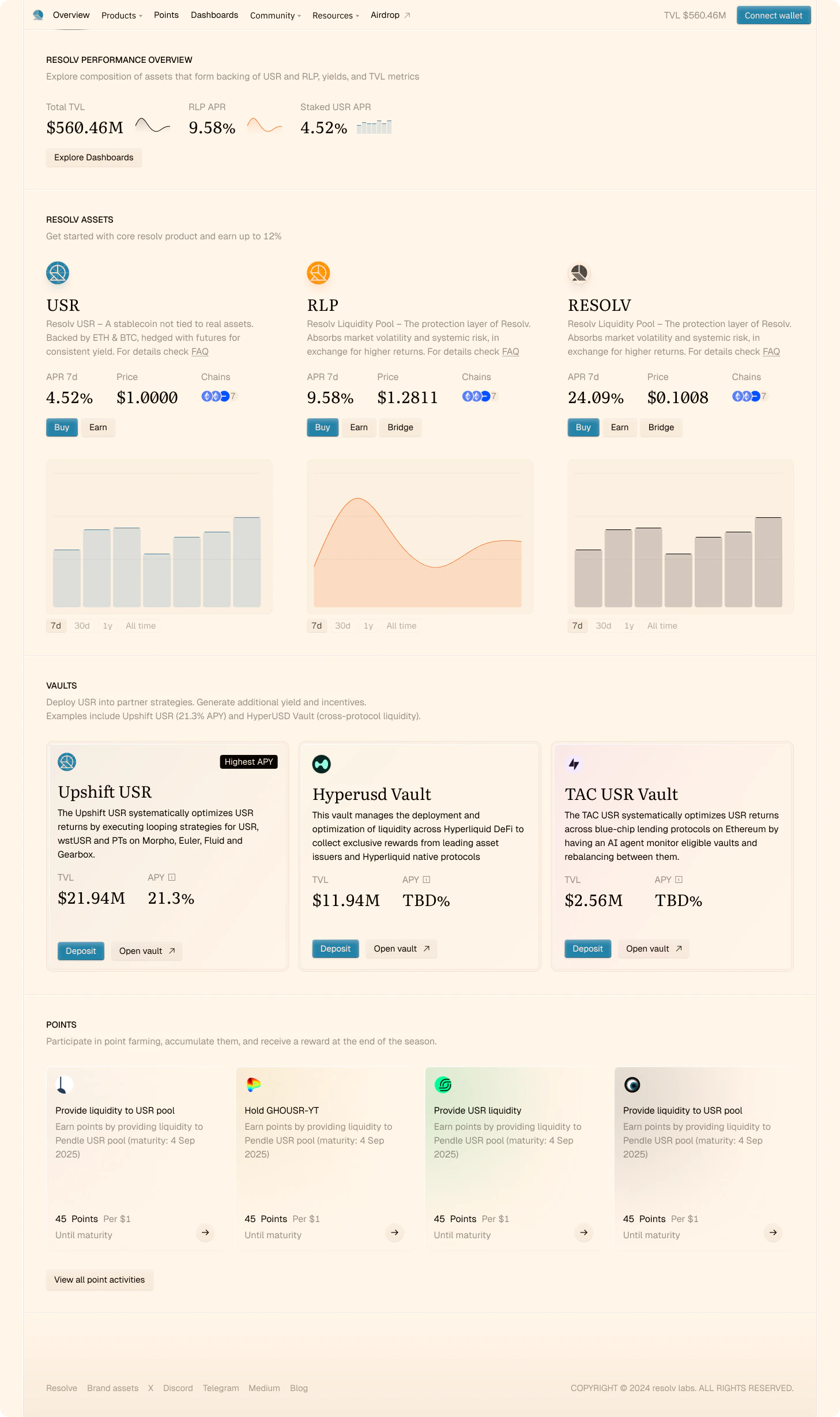
The web app became self-contained for first-time users
It included the minimum product context needed to understand Resolv without visiting the landing.
- Added asset descriptions
- Added charts
- Added available networks
- Added product performance
A 60% direct-entry lift added an estimated $10.2M in retail deposits
Direct-entry conversion rose from 10% to 16%, the full retail funnel grew by 12.7%.
- Direct entry: 10% → 16% (+60%).
- Overall retail funnel 16.5% → 18.6% (+12.7%).
- Retail deposits affected by this funnel: *$80M.
- Estimated additional retail deposits *$10.2M.
Measured on first-time retail users during 1 month. Direct-entry and landing-to-app cohorts were compared by completed first deposit.
The problem started before the deposit screen
The app was designed as a second step, but became the first for more users than expected.
We assumed people sharing Resolv would link to the landing, the clearest entry point for a new audience. Instead, they usually shared the last page they had open: the web app.
We had deliberately kept the app minimal by moving what looked like duplicate product explanation to the landing.
Across the full flow, that decision became a gap: for a much larger-than-expected audience, the web app was the first Resolv screen.